
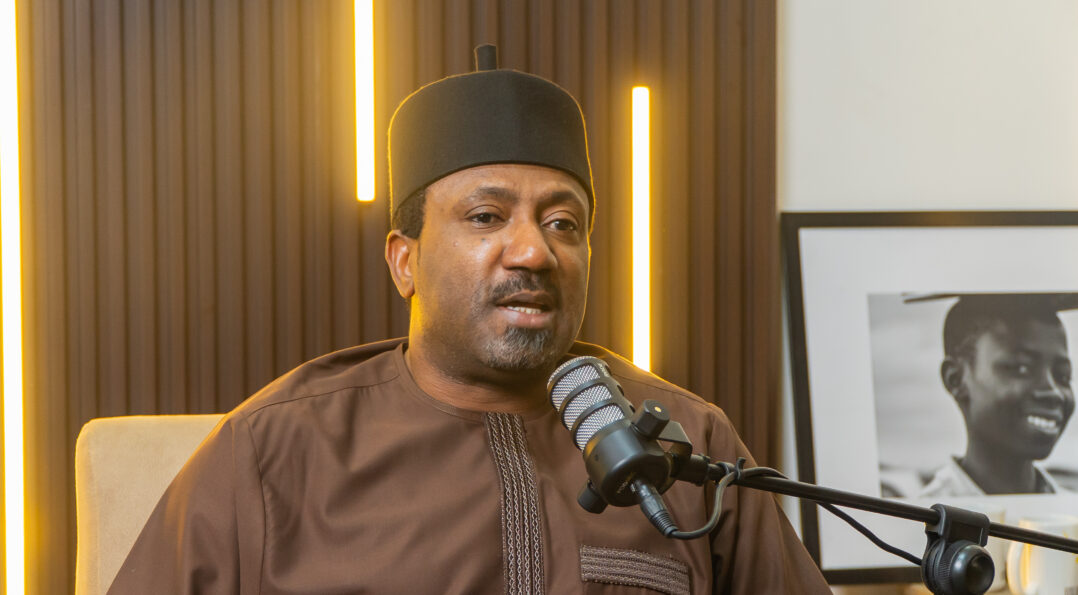
Nigeria should redefine its legal framework to treat high-level public sector corruption as a crime against the state equivalent to treason, a move that could significantly alter the risk-reward calculus for a political class accused of “scavenging” the nation’s wealth.
Dr. Umar Yakubu, Executive Director of the Center for Fiscal Transparency and Public Integrity, argued that the traditional definition of treason—historically tied to selling state secrets or supporting foreign enemies—is obsolete in an era where illicit financial flows pose a greater existential threat to the nation than external invasion.
“We need to transit from making corrupt offenses to become treasonable offenses,” Yakubu said in an interview with Volume with FemiDlive. “If you take money meant for a hospital… and you take it to another country, killing your own country, that is the context of why I feel we need to redefine treason” [15:45].
The proposal comes as Nigeria continues to bleed an estimated $15 billion annually in illicit financial flows [18:47]. For a nation grappling with a debt-servicing crisis and crumbling infrastructure, Yakubu contends that the $9 billion P&ID judgment saga—which Nigeria narrowly escaped—highlights how “treasonable acts” by officials can nearly bankrupt the state through fraudulent contracts and bribery [27:52].
The ‘Scavenging’ of Election Financing
A central pillar of Yakubu’s critique is the role of the Independent National Electoral Commission (INEC). He argues that INEC’s failure to enforce regulations on political party financing is the primary driver of public sector graft [43:06].
“The most important institution to solve the corruption problem is actually INEC,” Yakubu said, noting that the agency focuses almost exclusively on logistics while ignoring its powerful regulatory mandate over campaign spending [39:23].
The astronomical cost of seeking office in Africa’s most populous nation—where a gubernatorial run can cost tens of billions of naira—forces candidates to “scavenge” from government parastatals to recoup investments [42:51]. This creates a cycle where lawmakers and chief executives prioritize “recovering” their election funds over governance, leading to a system where “political interest comes first before national interest” [18:13].
Real Estate: The ‘Dumbest’ Money Laundering
Yakubu also pointed to the decoupling of Nigeria’s real estate market from its actual economic productivity. In the capital of Abuja, where luxury mansions are priced between 1 billion and 2 billion naira ($620,000 to $1.2 million), the advocate describes the sector as a massive, inefficient money-laundering machine for the political elite [36:28].
“The dumbest thing to do is to buy real estate… because they can’t even think of what to do” with stolen funds, Yakubu said [01:04]. He argued that because most Nigerian politicians lack backgrounds in wealth creation or industry, they simply “lock up capital” in property rather than investing in productive enterprises like pure water factories or studios, which require actual management and innovation [35:17], [36:11].
Transparency Gaps and the Religious Paradox
The Center for Fiscal Transparency’s recent “Transparency and Integrity Index” revealed a startling lack of openness among the country’s most powerful financial institutions. Agencies like the Federal Inland Revenue Service (FIRS) and the Accountant General’s Office have frequently landed in the “red zone” for failing to publish basic fiscal data [45:04].
Yakubu’s methodology is blunt: “The least transparent you are, the more corrupt you are” [45:50]. He notes that the 63 government-owned enterprises (GOEs) that generate their own revenue often operate as “fiefdoms,” spending billions on cars and fuel while the general population is told to endure the removal of fuel subsidies [47:38], [51:30].
The interview also addressed the paradox of Nigeria’s high religiosity—where 95% of the population professes a faith—and its pervasive corruption. Yakubu attributed this to an “externalization of religion” where ritual practices like leading prayers or attending church on Sundays are disconnected from internal morality [11:19].
The Path Forward
While President Bola Tinubu has focused on aggressive tax reforms and subsidy removals, Yakubu suggests the administration’s “political will” to fight corruption remains invisible [52:42]. He estimated that if just 10% of the energy used for tax reform was applied to fighting public sector corruption in the top 63 institutions, “corruption would drop by 90%” [54:07].
Until the cost of graft outweighs the benefit—potentially through the threat of the death penalty or life imprisonment associated with treason—Nigeria’s “shadow economy” will continue to outpace its formal one, leaving the state in a perpetual state of “bleeding” [18:39].